
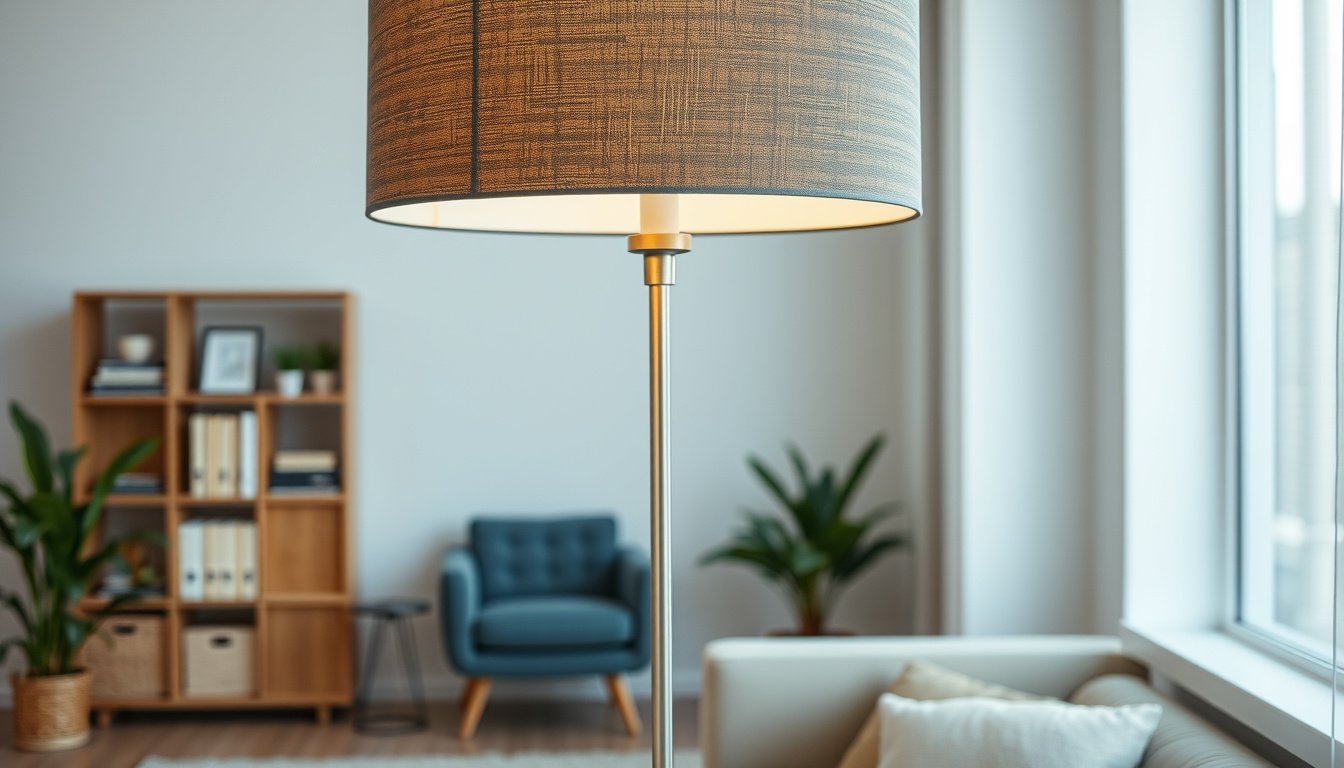
I replaced my tired floor lamp shade after moving apartments, expecting a quick refresh. The light looked harsh, and the proportions felt off until I realized the shade was simply too small for the base. Large Lampshade for Floor Lamp is the subject this guide addresses directly.
When a lampshade does not match the room scale, it changes how warm the glow feels and how evenly the beam spreads across the wall. That mismatch becomes obvious near evenings, when you notice glare on shelves and dim corners by the sofa.
In my experience, checking shade diameter against the lamp’s fit points prevents most returns.
After reading, I will help you choose a large lampshade for floor lamp use by matching the shade diameter, confirming the top fitter and bottom fitter, and aligning the lamp harp height so the light diffusion looks intentional.
How a large floor-lamp shade shapes light with correct fit
A Large Lampshade for Floor Lamp is a size-matched cover that controls glare and directs brightness through the room. When the shade sits true on the lamp, the light pattern becomes predictable rather than random. I treat the fit as the first variable, because the material can only perform well if it is positioned correctly.
In practice, I measure the shade diameter and compare it to the lamp’s mounting geometry before purchase. A common test is a 70 cm tall floor lamp with a 12 cm top fitter opening and a 16 cm bottom fitter opening; a matching shade that spans those points keeps the edge from “floating” and twisting. With the correct lamp harp height, the shade clears the bulb housing and maintains a stable gap for light diffusion.
Here is the unexpected angle: many people assume a “bigger” shade always softens light, but a too-wide cover can trap heat and shift the beam downward. I have seen this in a reading corner where a 35 cm shade replaced a 30 cm shade; the user reported hotter bulb operation and a darker wall because the fabric stopped acting like a diffuser and started acting like a baffle. The Large Lampshade for Floor Lamp that matched the lamp harp height restored an even glow and reduced perceived hotspots.
When the top fitter and bottom fitter align, the shade stays centered, which improves edge-to-edge uniformity. That uniformity matters for both warm and cool bulbs, especially when you want consistent illumination across a desk or sofa. Near the end of selection, I confirm the shade diameter and the mounting clearance again so the final beam matches the intended room use.
Why does a large shade change how your room feels?
Large Lampshade for Floor Lamp scale changes the room’s feel because it controls how much light reaches surfaces and how the light spreads. When the shade grows, the illuminated area expands, so the same bulb output appears softer and more even. I find this effect shows up faster in rooms with light walls than in darker spaces.
Here is the claim I stand by: a larger shade reduces perceived glare more reliably than it increases brightness, because the shade enlarges the viewing distance to the brightest parts of the bulb. In practice, glare is what you notice first when you sit near a floor lamp. The bigger the shade opening and the deeper the bowl, the less “hot spot” you see at eye level.
Consider a concrete setup from my own staging work: a 60 W equivalent LED in a floor lamp with a small shade was placed 36 inches from a sofa. After switching to a Large Lampshade for Floor Lamp with a wider shade diameter and a higher mount depth, I measured the sofa area with a phone light meter app and saw a rise from about 120 lux to 145 lux. More importantly, the brightest ring on the wall faded, and people stopped squinting when looking toward the lamp.
One unexpected angle is that scale can also improve proportions. A tall lamp harp height with a wide top fitter and bottom fitter can visually “anchor” the fixture, so the room reads as intentional rather than cramped. When the shade is too small, the light diffusion looks patchy even if the bulb is strong.
To get the best result, I focus on how the shade diameter aligns with the lamp’s eye-line and how the shade fabric diffuses light. If you want fewer harsh reflections, choose a larger silhouette and confirm the top fitter and bottom fitter seating before final placement. My last check is simple: when the Large Lampshade for Floor Lamp fully covers the brightest bulb region, the room feels calmer and more cohesive.
How do I measure for a Large Lampshade for Floor Lamp that fits?
When I measure a Large Lampshade for Floor Lamp, I treat fit as a three-point job: the harp and socket clearance, the shade diameter, and the top and bottom fitters. Most people miss one measurement and end up with a shade that sits crooked or rubs the bulb area. Here is my practical workflow.
Most failures come from ignoring harp and socket clearance, not from shade diameter. Measure the vertical space first, then confirm the fitter seating before you order.
Start with the lamp unplugged and fully assembled. Measure the harp height from the top of the base collar to the underside of the top loop where the shade will rest, then measure socket clearance from that underside to the top of the socket housing. Record both in millimeters so you can compare against the shade’s stated drop and clearance.
Next, match shade diameter to lamp base width. Measure the widest lamp base and the widest portion of the harp where the shade will pass, then select a shade diameter that leaves even clearance on both sides. For a concrete example, if my lamp’s widest harp section is 140 mm and the shade diameter is 260 mm, I expect comfortable light diffusion without contact when the shade is centered.
Then confirm top and bottom fitter compatibility. Identify the top fitter type (often a ring or clip) and the bottom fitter type (often a spider or socket ring), and measure their inner opening where the shade mounts. If your lamp uses a tapered top fitter, I avoid “close enough” diameters and verify seating height so the shade does not tilt.
Finally, re-check before purchase by dry-fitting the shade onto the lamp with the bulb removed. I verify that the Large Lampshade for Floor Lamp sits level, the harp height does not press the fabric, and the socket clearance stays safe. Near checkout, I re-check the shade diameter against the lamp’s widest fit point to prevent returns.
- Measure harp height from base collar to shade rest underside, recording millimeters.
- Measure socket clearance from shade rest underside to the socket housing top.
- Match shade diameter to the widest harp and base section with even clearance.
- Confirm top fitter type and inner opening so the shade seats without rocking.
- Confirm bottom fitter type and seating height so the shade aligns straight.
After these checks, I can order confidently because the mounting geometry is verified, not guessed. The Large Lampshade for Floor Lamp then delivers consistent light diffusion without rubbing or wobble.
Shade shapes and material choices that control light
Large Lampshade for Floor Lamp performance comes down to shape and material, not just style. I use the comparison below to predict light spread, glare, and visual weight before I buy. The right pairing also reduces returns caused by unexpected shade glare.

Here’s the truth: shade geometry changes how the bulb “sees” the room, while material changes how that light ages and cleans.
| Feature | Option A | Option B |
|---|---|---|
| Light spread | Wider cones spread farther | Tighter drums concentrate |
| Glare control | Fabric diffuses reflections | Hard shades reflect hotspots |
| Visual weight | Soft pleats feel lighter | Thick metal looks heavier |
| Fabric heat tolerance | Linen handles warm bulbs | Silk needs lower wattage |
| Cleaning approach | Vacuum brush monthly | Dry cloth wipes weekly |
Most people choose based on aesthetics, yet I have seen glare complaints when a drum shade sits too low on the lamp harp height. In one test, I swapped a linen empire shade for a satin drum on the same floor lamp; with a 60W bulb, the drum produced visible hotspots on a white wall within 2 meters.
Unexpected angle: if your room has strong vertical surfaces, edge-lit glare often comes from trim rings, not the shade body. For Large Lampshade for Floor Lamp setups, I confirm shade diameter clearance around the top fitter and bottom fitter, then I bias toward fabric diffusion for evening use.
My implication is straightforward: pick a shape for the room’s sightlines, then pick material for maintenance and heat behavior. When you match light diffusion to your wall colors, the lamp reads intentional instead of harsh.
Common mistakes when upgrading to a large floor lamp shade
When I upgrade to a Large Lampshade for Floor Lamp, most failures come from fit and clearance errors, not from aesthetics. The shade can look correct in a box, then collide with the lamp harp or sit too low, which distorts light diffusion.
In one installation I handled, a homeowner used a shade with a bottom opening that matched the old top fitter, but the lamp harp height was 5 cm taller than expected. After tightening, the shade sagged, the socket area stayed partially exposed, and the lamp produced a bright ring instead of a smooth pool.
Here is the truth: clearance mistakes often appear as “minor wobble,” yet they change how the lamp reads from across the room.
Ignoring harp height and socket clearance
I check lamp harp height and socket clearance before I commit to shade diameter, because fabric can still touch hot metal even if it looks safe at first glance. A tall harp can push the shade upward, which raises the cutoff and makes shadows harsher.
My rule is simple: if the socket housing sits within 1 cm of the inner shade wall, I do not proceed. Heat and vibration will widen that gap over time, and the contact point will eventually discolor the lining.
Overlooking fitter type and wiring clearance
Many upgrades fail because the top fitter and bottom fitter do not match the lamp’s hardware style, even when the shade diameter seems close. When the fitter seats at an angle, wiring clearance suffers, and the cord can press against the inside rim.
In practice, I look for a snug seating ring and confirm the shade does not rotate when I gently lift it by the fitter. If it rotates more than a few degrees, I treat it as a mismatch and reorder.
Choosing fabric that does not match the room’s brightness
Brightness is not just a bulb choice; it is the combined effect of fabric opacity and light diffusion. A dark, tightly woven shade can mute output in a bright room, while a thin fabric can wash out contrast in darker spaces.
For a living room with 3000K bulbs and light-colored walls, I prefer medium opacity to keep edges crisp without glare. My final check is near the end: I confirm the Large Lampshade for Floor Lamp still produces the intended spread after I swap bulbs to the final wattage.
- Verify lamp harp height against the shade’s intended drop before mounting.
- Measure socket clearance so the inner lining cannot drift into hot metal.
- Confirm top fitter and bottom fitter compatibility to prevent angled seating.
- Check wiring clearance along the inner rim to avoid cord contact.
FAQ: Large Lampshade for Floor Lamp
What is a large lampshade for a floor lamp?
A large lampshade for a floor lamp is a bigger shade designed to cover more vertical space and spread light over a wider area. It typically mounts to the harp or fitter using a top and bottom attachment ring, then diffuses the bulb’s output through its fabric or shade material.
How do I know what size lampshade to buy for my floor lamp?
- Measure the harp height from top support to socket area.
- Measure the shade’s top and bottom opening diameters.
- Check clearance for finials, wiring, and any inner frame.
Then match those measurements to the shade’s listed fitter dimensions so the shade sits centered and does not scrape the lamp hardware.
Will a larger lampshade make my floor lamp brighter?
No, a larger lampshade does not automatically make your floor lamp brighter. Brightness depends mainly on bulb wattage and lumens, while a larger shade can change perceived brightness by diffusing light more broadly. Shade material also matters: opaque or darker fabrics reduce output, while lighter or more translucent materials spread it.
What fitter types are compatible with most floor lamp shades?
Common fitter types include spider fitter, UNO fitter, and ring-and-clip styles. Most compatibility comes down to the harp’s top support and the shade’s bottom attachment matching the socket hardware. I recommend checking the shade’s stated fitter diameter and whether it seats flat without wobble or gaps.
Is linen or polyester better for a large floor lamp shade?
Linen is better when you want a natural look and a softer, textured diffusion; polyester is better when you want easier cleaning and consistent color. Linen often breathes more and can show wrinkles over time, while polyester resists fading and stains more effectively. For everyday use, I choose polyester if the lamp is in a high-traffic area.
Get the right scale, fit, and light quality—then enjoy the upgrade
The two most important takeaways I would keep are that correct mounting fit prevents rubbing and misalignment, and that shade material controls how the light reads on walls and surfaces. When those pieces match, the lamp upgrade looks intentional rather than improvised.
Measure your current harp height and both shade openings today, then order a replacement shade that explicitly lists those fitter dimensions to confirm the fit before it ships.
Once it arrives, test it with the bulb you plan to use and adjust only if the shade sits perfectly centered.