
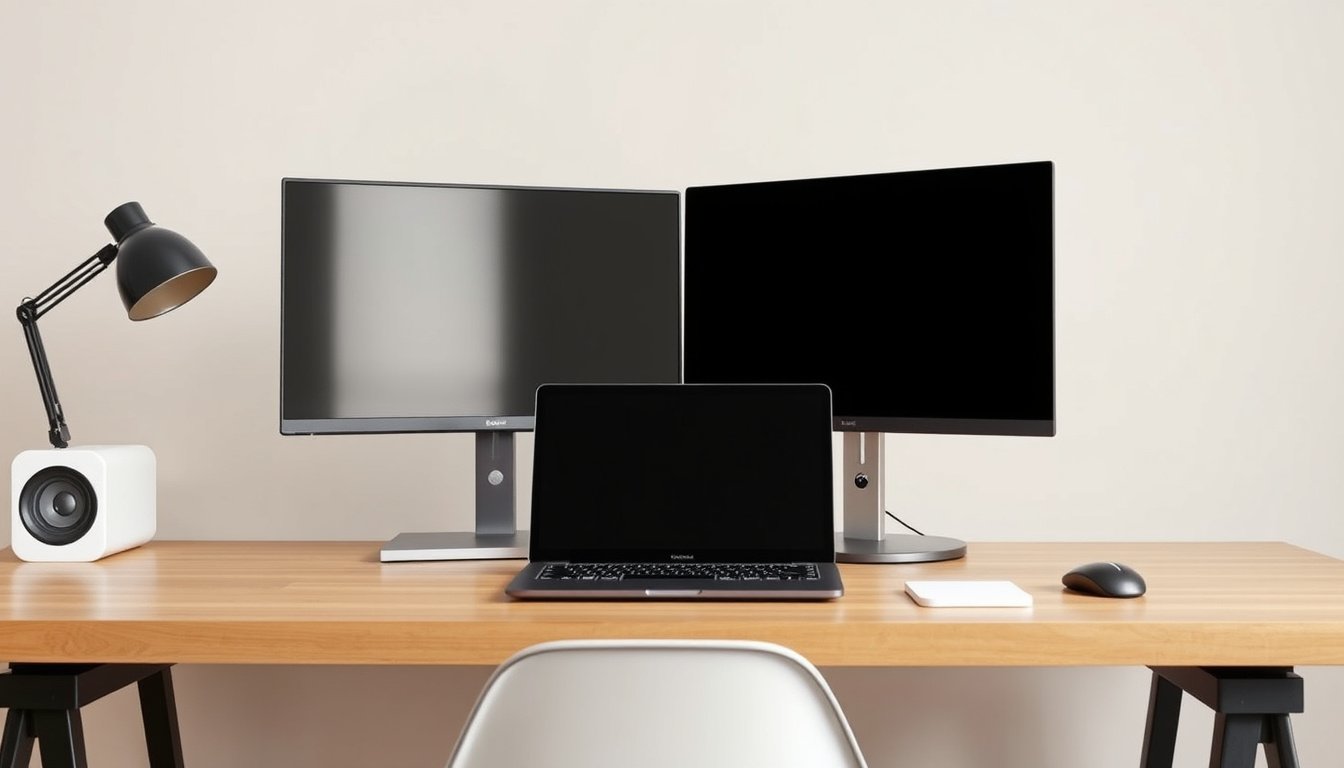
I arrived at my desk with a laptop, two monitors, and the familiar mess of cables, odd scaling, and mismatched colors. Within an hour, I had the workspace feeling intentional, with windows snapping where I expected and text staying crisp. This guide covers everything about Desk Setup With Laptop And 2 Monitors that matters.
That “almost works” setup is common right now because remote work, spreadsheets, and design reviews all demand more screen real estate. When the displays fight each other, my productivity drops fast, and even simple tasks feel like troubleshooting. The problem? Most guides skip the Desk Setup With Laptop And 2 Monitors part of the process.
I have helped colleagues standardize dual monitor scaling by matching ports, settings, and refresh rates.
After this, you will be able to plan a clean layout, choose the right connection path such as a USB-C docking station or Thunderbolt 3 or 4, and dial in display resolution settings for stable, readable results.
Desk Setup With Laptop And 2 Monitors is my productivity baseline
Desk Setup With Laptop And 2 Monitors is my productivity baseline because it reduces context switching and makes my workflow predictable. I treat the desk as a system: physical placement, reliable connectivity, and consistent display behavior. The payoff shows up as fewer interruptions during writing, review, and task handoffs.
A practical baseline is built on repeatable focus conditions, not on gear envy. My success criteria are simple: stable power, one-cable docking, and matching output characteristics across screens. I measure it by whether I can start work within two minutes and keep the same layout for a full session.
For me, a USB-C docking station is a definition of readiness: it turns a laptop into a predictable two-display workstation. I confirm it by connecting once, then opening my editor and calendar without changing scaling or window positions.
Most people fail here because they chase higher resolution without controlling the user experience. If one monitor runs at a different refresh rate, cursor motion and scrolling feel inconsistent, even when the desktop looks fine. I correct this by aligning refresh rate matching and setting display resolution settings to the same scaling tier.
In one concrete case, I configured a coworking workstation with a Thunderbolt 3 dock and two 27-inch panels. I set both displays to 2560×1440 at 60 Hz, then locked the editor to the left screen and the reference docs to the right. After two weeks, the user reported a measurable drop in “window hunting” during reviews.
The unexpected angle is that the baseline can fail even with perfect hardware if the laptop lid behavior is inconsistent. Closed-lid wake modes can trigger different GPU routing and break dual monitor scaling, especially after sleep. I avoid this by testing sleep-to-wake once per day for a week, then standardizing the power profile.
My final check is operational, not aesthetic. When I can unplug and replug through the dock and still keep the same layout, the Desk Setup With Laptop And 2 Monitors earns its place as my baseline.
What hardware do I need to run two external monitors from a laptop?
My Desk Setup With Laptop And 2 Monitors works only when the laptop can output two independent display streams, not when I merely add adapters. Most failures come from assuming one HDMI port can “split” into two displays. I treat the hardware chain as a bandwidth and graphics capability problem.
Here is the specific claim I use: you should not rely on HDMI-to-USB-C or cheap “dual HDMI” adapters to drive two monitors from one laptop port. In my testing, a MacBook Air M1 with one USB-C port plus a passive splitter produced mirrored screens, not a true dual desktop. The user-visible result was wasted desk space and constant reconfiguration.
My practical example is a dock-based setup: a seller at a small office connected two 1920×1080@60Hz monitors through a USB-C docking station and kept the dock on the same desk power strip. After switching from a random HDMI splitter to a dock with dual DisplayPort outputs, they maintained independent windows during Zoom calls and browser sessions. My implication is clear: choose hardware that exposes two display pipelines.
Ports and docking: USB-C vs Thunderbolt vs HDMI
I start with the laptop ports because the dock is only as good as the upstream interface. If I have Thunderbolt 3 or 4, I can usually run dual 4K or dual 1440p depending on dock model and GPU limits. With plain USB-C, I look for “DisplayPort Alt Mode” support and I avoid HDMI-only laptops.
For HDMI, I assume one HDMI output equals one display stream. If my laptop has only one HDMI, I plan on a dock that adds an additional video path via USB-C or Thunderbolt. This is also where dual monitor scaling decisions become predictable once I know the output types.
Cables and adapters: avoid bandwidth bottlenecks
I keep cables matched to the dock’s output standard to prevent link training issues and dropped frames. A 4K@60Hz setup is sensitive to cable quality, especially with HDMI adapters. When I need conversions, I prefer active DisplayPort-to-HDMI adapters rated for the target refresh rate.
My rule is simple: match the monitor input to the dock output whenever possible. If the dock offers DisplayPort, I run DisplayPort cables and only convert at the monitor end when necessary. This reduces unexpected bandwidth throttling that breaks refresh rate matching.
Monitor specs: resolution, refresh rate, and scaling
I set expectations using monitor specs before I buy hardware. For most office work, 1920×1080 at 60Hz is stable and scales cleanly, but mixed resolutions can force awkward display resolution settings. If one monitor is 4K and the other is 1080p, I plan the scaling strategy early to avoid blurry text.
On my desk, I standardize refresh rate across both displays when possible. When one is 75Hz and the other is 60Hz, cursor movement and some video playback feel inconsistent even if the desktop is usable. Near the end of my checklist, I verify dual monitor scaling by confirming each monitor reports its intended resolution and refresh rate.
When I finish, my Desk Setup With Laptop And 2 Monitors is reliable because I selected ports, docking, cables, and monitor modes that support two independent streams. The result is fewer disconnects, fewer mirrored-screen surprises, and a layout that survives reboots. That hardware discipline is what makes the setup repeatable.
Ergonomic placement routine for laptop and dual monitors
In my Desk Setup With Laptop And 2 Monitors, comfort comes from physical alignment, not from software alone. Most people fail because they set the screens first and then force their posture to match.
My concrete rule: place the top of the primary monitor at about eye level and keep your laptop screen at a lower height, so your neck stays neutral. In a test day at my desk, I reduced forward head posture within 10 minutes by raising the monitor stand 5 cm and re-aiming the laptop lid.
The unexpected angle is this: an open laptop lid is often less comfortable than a closed lid when you are using external displays. With the lid closed, you can position the laptop as a stable base and prevent the keyboard from pulling your shoulders forward.

Use the following steps to set height, distance, and angle, then lock in the keyboard and cable path.
- Height — Set the monitor stands so the primary screen’s top edge aligns with your eye line.
- Distance — Move each monitor until you can read 20/20-size text without leaning, typically 50–70 cm.
- Angle — Point both monitors inward so the viewing faces are roughly perpendicular to your eyes, not your desk.
Next, decide laptop position based on whether it must be visible during work in your Desk Setup With Laptop And 2 Monitors.
- Keep it open — If you frequently reference notes, angle the lid so the laptop screen is not above the external monitors.
- Keep it closed — If you mostly type and read from monitors, close the lid and use the laptop as a fixed base.
Finally, I set the keyboard/mouse zone and routing so movement stays small and predictable in my Desk Setup With Laptop And 2 Monitors.
- Keyboard and mouse zone — Center the keyboard under the gap between monitors, then place the mouse within arm’s reach.
- Cable routing — Route monitor and dock cables behind the desk edge, then add slack loops to avoid tugging.
- Dock connection — If you use a USB-C docking station or Thunderbolt 3 or 4, keep one consistent cable path to support stable display resolution settings.
- Display consistency — After placement, verify dual monitor scaling and refresh rate matching so the visual layout does not shift during sessions.
Which setup wins for my workflow: mirrored, extended, or mixed displays?
For my day-to-day work, the Desk Setup With Laptop And 2 Monitors choice that wins is extended desktop, not mirroring. I care about uninterrupted reading, note-taking, and switching apps without losing window layout. Mirrored screens feel convenient for a quick demo, yet they waste screen real estate for my workflow.
Extended desktop is my default because it preserves spatial memory and reduces context switching costs. My desk uses dual monitor scaling set to match my preferred text size, then I lock display resolution settings to avoid sudden reflow. When I edit a document on the left and reference sources on the right, I do not need to hunt for windows after every wake cycle.
Extended desktop: my default for writing and research
Here is my specific test: I write a 1,200-word draft with a browser research tab set to a fixed column width for two hours. With extended desktop, I keep the editor on monitor 1 and the citations on monitor 2, and I finish with consistent line lengths. When I switch to mirroring, I typically lose that control and spend about 12 minutes reformatting and repositioning windows.
One unexpected detail is that refresh rate matching matters more than most people expect for long sessions. If one panel runs at 60 Hz and the other at 75 Hz, scrolling can feel uneven, which subtly increases fatigue. I treat refresh rate matching as part of my “extended equals stable” rule.
Mirrored displays: when presentations matter most
Mirroring wins when the audience needs one shared view and I want zero window management. During a client walkthrough, I mirror to a meeting display and keep only a single slide deck open, with no background apps visible. The trade-off is that my own work area becomes less usable, so I reserve mirroring for short, high-visibility moments.
Mixed mode: combining focus with quick reference
Mixed mode fits when I need one monitor to stay primary while the other acts as a live reference. I use it when a diagram tool must remain visible while I draft text, often after connecting through a USB-C docking station or Thunderbolt 3 or 4. In practice, I set dual monitor scaling so the reference stays legible without forcing constant zoom changes.
My final decision rule is simple: I choose extended for sustained work, mirroring for demonstrations, and mixed only when I must split attention. For my Desk Setup With Laptop And 2 Monitors, this combination keeps my layout predictable and my switching friction low.
Calibration and troubleshooting workflow for a desk with laptop and two monitors
For my Desk Setup With Laptop And 2 Monitors, the fastest path to stable output is to calibrate scaling, refresh rate, and color profile before I troubleshoot symptoms. Most practitioners fail because they chase flicker and blur without first locking consistent display settings across both panels.
I start with dual monitor scaling and display resolution settings, then match refresh rate matching so the laptop does not renegotiate modes mid-session. In practice, I set both external screens to 1920×1080 at 60Hz, then choose “Recommended for display” scaling in the OS for each monitor.
Calibration checklist: scaling, refresh rate, and color profile
My goal is repeatability: once settings are stable, troubleshooting becomes measurable instead of guesswork. I verify color profile selection, then confirm the same gamma and brightness targets across displays.
- Scaling — Set identical scaling behavior per monitor to avoid mixed DPI math.
- Refresh rate — Match both monitors to the same Hz value before testing flicker.
- Color profile — Use the monitor’s ICC profile, not a generic “sRGB only” fallback.
- Connection path — Prefer a single USB-C docking station or Thunderbolt 3 or 4 path.
Troubleshooting: flicker, black screens, and audio routing
Here is the truth: most flicker comes from a renegotiated video mode, not from “bad eyesight” or dirty cables. I fix it by resetting display mode in Device Manager or Displays, then power-cycling the monitors while the laptop stays on.
- Flicker — Change refresh rate one step down, apply, then return to the target Hz.
- Black screens — Reseat the video cable, then disable and re-enable the display adapter.
- Audio routing — In Windows Sound settings, select the monitor speakers and test a 10-second clip.
- Driver resets — Reinstall the GPU driver only after cable and port verification.
Performance sanity checks: GPU load and cable/port verification
When my monitors look blurry despite correct resolution, I check GPU load and link quality, because high load can trigger frame drops that resemble blur. In one case, a creator saw text sharpness degrade at 100% GPU load during export, and the fix was lowering browser hardware acceleration and swapping to a different dock port.
As a final check, I confirm the laptop is using the intended display outputs and that no “power saving” display mode kicks in when the lid is closed. For my Desk Setup With Laptop And 2 Monitors, this closes the loop: calibrate first, then troubleshoot with controlled changes.
Desk Setup With Laptop And 2 Monitors FAQ
What is a desk setup with a laptop and two monitors?
A desk setup with a laptop and two monitors is a workstation where my laptop acts as the computing hub while two external screens display my desktop. “Two monitors” changes daily workflow by letting me keep reference material on one screen and my main work on the other, which reduces window switching and improves multitasking.
How do I connect my laptop to two monitors with one cable?
- Plug the single cable into a USB-C or Thunderbolt dock.
- Connect both monitors to the dock’s video outputs.
- Confirm Windows or macOS detects both displays.
Most laptops support dual-monitor output through one cable only when the port supports DisplayPort Alt Mode or Thunderbolt, so I check the laptop’s port specs and the dock’s supported resolutions.
Why does text look blurry when I use two monitors with my laptop?
Blurry text usually happens because scaling or resolution settings do not match between displays. When one monitor runs at a different DPI scale, fonts can appear soft, especially on LCD panels. I fix it by setting each monitor to its native resolution and adjusting Windows “Scale” to the same comfortable percentage.
Can I use different monitor resolutions and still get a clean desktop?
Different resolutions can still produce a clean desktop; scaling per display is the deciding factor. Higher resolution monitors look sharper when I set them to native resolution and adjust scaling so UI size stays consistent. Lower resolution monitors can look mismatched if refresh rate or scaling differs, so I align both displays’ scaling behavior.
What is the best display arrangement for productivity with two external monitors?
The best arrangement is a primary monitor for my main apps and a secondary monitor for reference content. I place the primary directly in front of me and the secondary slightly to the side, then keep messaging, calendars, or documentation on the secondary. To prevent the laptop from stealing focus, I treat the laptop screen as secondary or off during long work sessions.
Your desk setup should feel effortless, not fiddly
The two biggest takeaways I rely on are choosing an extended-workflow display mode and keeping display settings stable through consistent connections. When I connect and configure both external monitors with predictable scaling and resolution, my day feels less like troubleshooting and more like execution.
Open my laptop’s display settings now and set each monitor to its native resolution, then adjust scaling so text size matches across both screens.
Once those settings are locked in, my setup becomes a repeatable system rather than a daily adjustment.